
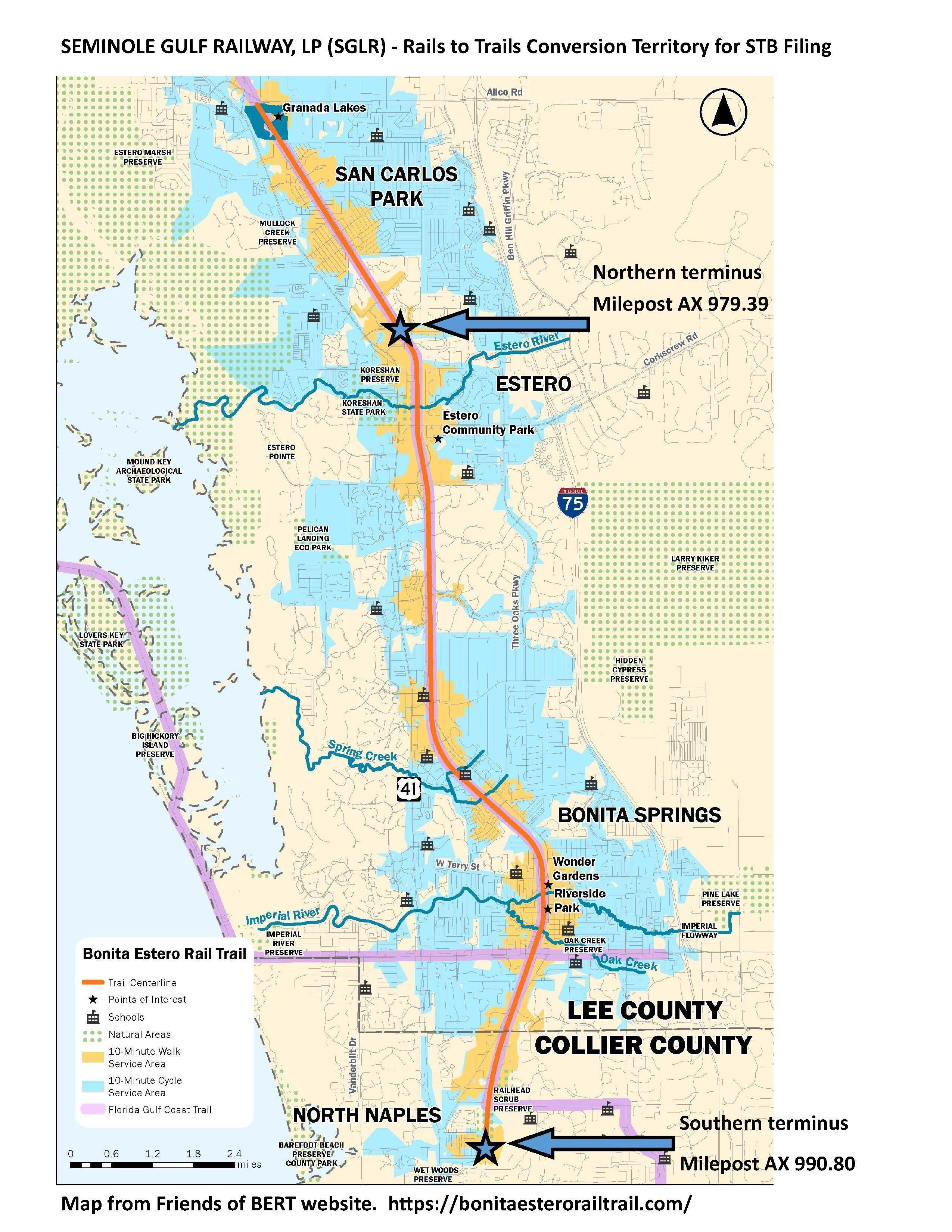
On July 1, 2026, an important development occurred in the proposed Bonita Estero Rail Trail project. The Trust for Public Land (TPL) filed a formal request with the Surface Transportation Board (STB) asking the Board to issue a Notice of Interim Trail Use (NITU) for approximately 11.4 miles of the Seminole Gulf Railway corridor extending from Estero through Bonita Springs into Collier County.
While many people view rail-trails as recreational amenities, adjacent landowners should understand that a rail-to-trail conversion can have significant legal consequences for private property rights. In many cases, the conversion may give rise to a claim for compensation under the Fifth Amendment to the United States Constitution.
What Is the Bonita Estero Rail Trail?
The proposed trail would follow a former Seminole Gulf Railway corridor through Bonita Springs and Estero, creating an off-road route for biking, walking, running, and everyday transportation. Supporters describe BERT as a future link in the larger Florida Gulf Coast Trail network, a regional trail system intended to connect communities from Collier County toward the Tampa Bay area.
How Will the Bonita Estero Rail Trail Affect Adjacent Property Owners?
The Bonita Estero Rail Trail has the potential to become a valuable recreational resource for Southwest Florida. At the same time, however, it may also permanently change the relationship between adjacent landowners and the railroad corridor behind their property.
For many homeowners, the railroad right-of-way has existed for decades with little activity. A recreational trail, however, often brings a continuous stream of pedestrians, bicyclists, runners, and other public users immediately adjacent to private property.
Depending on the location, landowners may experience:
- A significant increase in foot and bicycle traffic behind or alongside their property.
- Reduced privacy as trail users gain direct views into backyards, pools, patios, and outdoor living spaces.
- Increased noise from year-round recreational use.
- Concerns about trespassing, litter, vandalism, or unauthorized access onto private property.
- Additional expenses for fencing, landscaping, or other privacy measures.
- Changes in how the property is used and enjoyed.
Every property is different, and not every landowner will experience the same impacts. However, the law recognizes that converting an inactive railroad corridor into a public recreational trail is fundamentally different from operating a railroad.
The Latest Development
According to the filing submitted to the Surface Transportation Board:
- The Trust for Public Land is planning to request a Notice of Interim Trail Use (NITU) for the Bonita Estero corridor.
- The proposed corridor extends approximately 11.4 miles from Estero Parkway (Milepost AX 979.39) south through Bonita Springs to Wiggins Pass Road (Milepost AX 990.80) in Collier County.
- TPL has agreed to assume the financial responsibilities required under the National Trails System Act if the railbanking process moves forward.
Why This Matters
Many railroad corridors were originally acquired only as railroad easements, not outright ownership.
When a railroad stops operating trains, many landowners assume the easement simply ends and the property returns to them. However, under the federal National Trails System Act, an abandoned railroad corridor can instead be converted into a recreational trail through a process known as railbanking.
When that occurs, federal law can prevent adjoining landowners from regaining possession of their property.
If the railroad held only an easement, the railbanking process may constitute a taking of private property requiring the federal government to pay just compensation under the Fifth Amendment.
Every property is different, and eligibility depends on the property's chain of title and the railroad's property interest.
What Landowners Need to Know
If your property borders the proposed Bonita Estero Rail Trail, you should understand several important points:
- You may own part of the railroad corridor.
Many adjoining landowners are surprised to learn they may own the land beneath the railroad, subject only to a railroad easement.
- A trail conversion does not automatically mean compensation.
Although the trail may proceed, and you may have the right to seek compensation from the federal government if a taking has occurred, you will need to take affirmative action by filing a claim. The government will not voluntarily pay you for the taking of your land or the burden of now having a trail along your property.
- Compensation is based on property value.
Compensation varies from property to property and depends on numerous factors, including the property's location, size, frontage, and the nature of the railroad's property interest.
- There is a deadline.
Rails-to-Trails claims are governed by strict federal filing deadlines. Waiting too long can permanently bar an otherwise valid claim.
Why You Can Act Now
The filing submitted on July 1 is an important procedural step in the federal railbanking process. Once the Surface Transportation Board issues a Notice of Interim Trail Use (NITU), important legal deadlines begin running when the lawsuit is filed.
The best time to evaluate your rights is before those deadlines expire.
An early review allows experienced Rails-to-Trails counsel to:
- Determine whether your property is adjacent to the corridor.
- Review historical deeds and title documents.
- Analyze whether the railroad owned an easement or fee interest.
- Preserve your right to pursue compensation if a taking has occurred.
Waiting until construction begins—or after the trail opens—may be too late.
How Stewart, Wald & Smith Can Help
Our firm focuses exclusively on representing property owners in Rails-to-Trails and railroad takings cases throughout the United States.
We assist landowners by:
- Determining whether their property is affected.
- Researching historical railroad deeds and title records.
- Evaluating ownership interests along the corridor.
- Pursuing compensation in the United States Court of Federal Claims when appropriate.
Our attorneys have represented thousands of landowners in railbanking cases nationwide and understand the complex legal and historical issues involved in these claims. We have in-depth knowledge and experience with the case law, Court of Federal Claims Judges, and Department of Justice attorneys who defend these claims.
Why Compensation Matters
Many property owners understandably ask, "If the trail is being built anyway, why should I pursue compensation?"
The answer is simple: compensation is intended to recognize the property rights that may have been affected.
The Fifth Amendment to the United States Constitution provides that private property shall not be taken for public use without just compensation. If the federal railbanking process prevents a railroad easement from terminating and instead preserves it for trail use, some landowners may have the right to recover compensation for that loss of property rights.
That compensation can help offset the long-term effects of living next to a public trail.
For some landowners, compensation may help pay for:
- Privacy fencing or landscaping.
- Security improvements such as lighting or cameras.
- Property enhancements that restore privacy and enjoyment.
- The reduction in value associated with the government's continued use of the corridor.
For others, compensation simply recognizes that they have lost the opportunity to regain full ownership and exclusive use of property that otherwise may have reverted to them.
Importantly, compensation is not based on whether someone supports or opposes the trail. Many property owners appreciate the recreational opportunities a trail provides while also believing they should be fairly compensated if the federal government has taken a protected property interest.
Find Out if Your Property May Qualify
If your property is located along the proposed Bonita Estero Rail Trail corridor in Estero or Bonita Springs, now is the time to have your property reviewed.
A consultation can help determine whether your property may be affected and whether you may have a claim for compensation before important federal deadlines pass.
Contact Stewart, Wald & Smith today for a complimentary evaluation of your property rights.
Learn more about the Bonita Estero Rail Trail Plans.
The choice of a lawyer is an important decision and should not be based solely upon advertisements. Disregard this solicitation if you have already engaged a lawyer in connection with the legal matter referred to in this solicitation. You may wish to consult your lawyer or another lawyer instead of me (us). The exact nature of your legal situation will depend on many facts not known to me (us) at this time. You should understand that the advice and information in this solicitation is general and that your own situation may vary. This statement is required by rule of the Supreme Court of Missouri.