Do you own land along the future Bonita Estero Rail-Trail?
YOU MAY QUALIFY FOR COMPENSATION FROM THE FEDERAL GOVERNMENT.
Contact us for a free case evaluation.
HISTORY OF THE BONITA ESTERO RAIL-TRAIL CONVERSION PLAN
The proposed Bonita Estero Rail Trail (“BERT”) is a planned rails-to-trails conversion along approximately 11.4 miles of former railroad corridor extending from Estero south through Bonita Springs and into Collier County near Wiggins Pass Road. According to Seminole Gulf Railway’s May 2026 Environmental/Historic Report filed in connection with a planned abandonment proceeding before the Surface Transportation Board (“STB”), the corridor runs from approximately Milepost AX 979.39 in Estero to Milepost AX 990.80 near North Naples. The report explains that Seminole Gulf Railway acquired the line from CSX Transportation in 1987 and that rail traffic steadily declined over the following decades, with the last freight operations ending in 2008. The corridor itself traces back to historic rail operations serving southwest Florida, including rail service into Naples prior to the discontinuation of passenger operations around the creation of Amtrak in the early 1970s.
Local advocacy efforts for conversion of the corridor into a public trail have accelerated in recent years. The Friends of the Bonita Estero Rail Trail organization has promoted the project as a regional multimodal corridor intended to connect neighborhoods, schools, parks, preserves, and commercial districts throughout Estero and Bonita Springs. Maps included in the abandonment filing—sourced directly from the BERT organization—show the corridor linking into broader trail networks and serving major community destinations. The STB filing further confirms that Seminole Gulf Railway “understands that interest exists to convert the Subject Line into a trail” and that the railroad intends to transfer the property for trail use following abandonment proceedings. The abandonment process is proceeding through STB Docket No. AB 400 (Sub-No. 8X), with notices specifically advising that requests for railbanking and trail use may be filed with the STB.
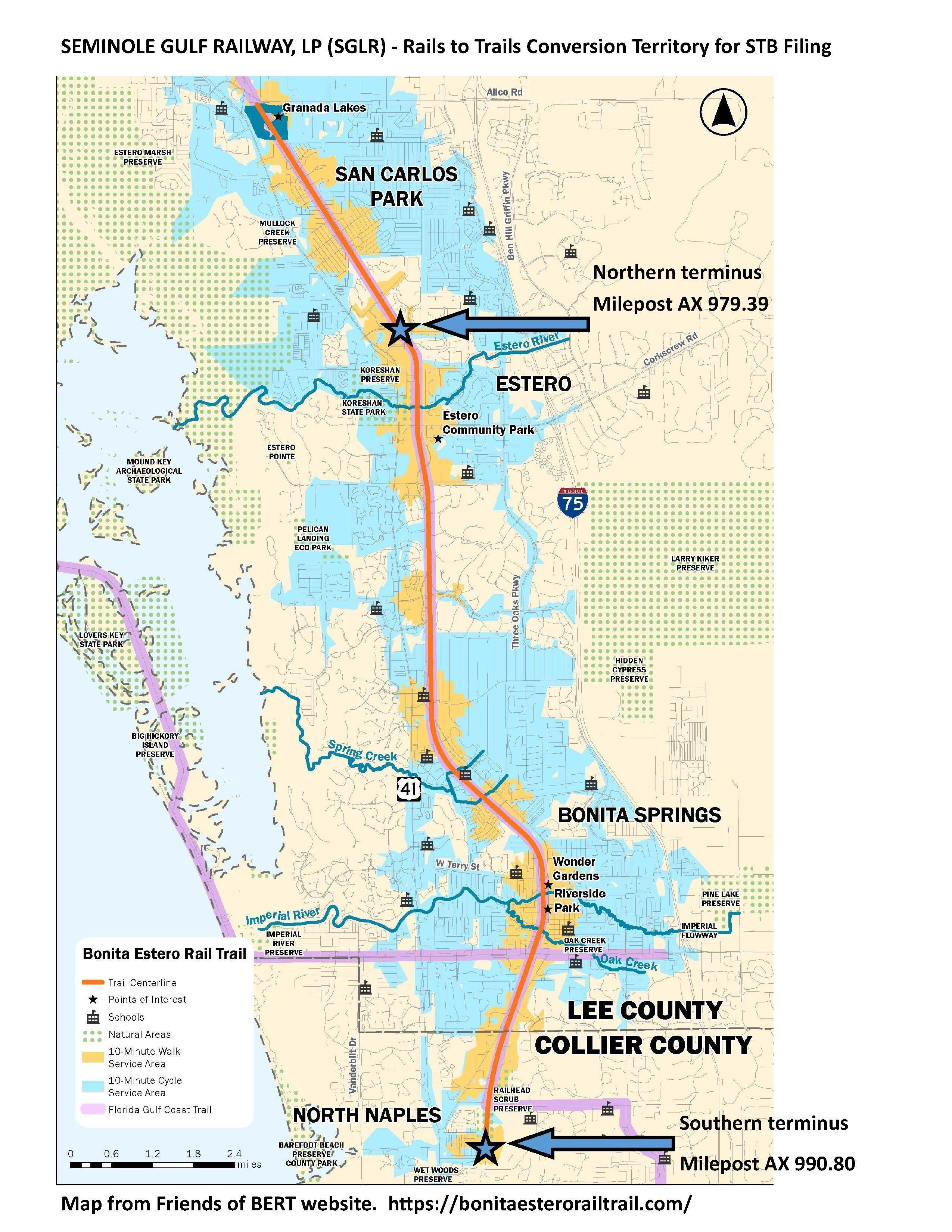
Seminole Gulf Railway, L.P. (“SGLR”) intends to file a notice of exemption for SGLR to abandon the following segment of rail line (the “Subject Line”): between the northern right-of-way boundary of Estero Parkway at approximately SGLR Milepost AX 979.39 in the Village of Estero, FL (Lee County) south through the remainder of Estero, and through the City of Bonita Springs, FL (Lee County, and continuing into Collier County, FL) to the corridor’s terminus at the conceptual northern right-of-way extension of the Wiggins Pass Road, at approximately SGLR milepost AX 990.80.
What is the United States Trails Act?
The Trails Act is a federal program that permits the conversion of railroad lines into nature and hiking trails. In this instance, the trail would comprise various segments of the Bonita Estero Rail Trail.
These potential claims result from the blocking of reversionary property rights in the railroad corridor, based on Florida property law. In some cases, an owner of land that abuts a public right of way (in this case a former railroad corridor) is presumed to own a portion of the land within the right of way, such that when the railroad was ever abandoned the land would revert to their ownership. This is what should have occurred with respect to the land planned to be the future Bonita Estero Rail Trail. This taking would require the United States to pay landowners just compensation under the Constitution. It is important to note that a claim like this would only be against the federal government and is NOT adverse to the Bonita Estero Rail Trail or any local entity sponsoring the trail.
Stewart, Wald & Smith's practice focuses on what is commonly referred to as "Rails to Trails" litigation. These cases seek compensation from the federal government as a result of state-law property rights being blocked by the instituting of the federal government's Rails to Trails program. We believe your property may have a claim for compensation once the inactive Seminole Railway's line is converted into the Bonita Estero Rail Trail.
Our firm would like to evaluate your potential claim. Complete the form on this page for a free case evaluation.
Rail-to-trail conversions are only possible thanks to the Trails Act, an act of Congress that allows railroads to offer up their railroad rights-of-way for public recreational hiking and biking use in lieu of abandonment.
WHAT CAN STEWART, WALD & SMITH DO FOR YOU?
Landowners whose property is taken for recreational trails rely on Stewart, Wald & Smith to recover money for them from the government. We have recovered more money in Rails-to-Trails litigation than any other law firm: $390 Million and counting.
Our firm has extensive experience handling Rails to Trails cases asserting the property rights of landowners against the federal government in the United States Court of Federal Claims. We encourage you to review our listing of successful cases and compare it with other firms. Our specialized experience and skills have driven our unparalleled success, involving land in over 29 states.
At Stewart, Wald & Smith, our dedicated team takes pride in making your claims process clear and simple. You will never pay any fee unless the case is successful, and even then, the fee comes out of the award, and not your pocket. If we are not successful in the lawsuit, you do not pay our firm any fees or expenses whatsoever. If you would like to discuss your claim and understand your rights in more detail, please contact us.

Bonita Estero Rail-Trail Blog & News
DISCLAIMER
The choice of a lawyer is an important decision and should not be based solely upon advertisements. Disregard this solicitation if you have already engaged a lawyer in connection with the legal matter referred to in this solicitation. You may wish to consult your lawyer or another lawyer instead of me (us). The exact nature of your legal situation will depend on many facts not known to me (us) at this time. You should understand that the advice and information in this solicitation is general and that your own situation may vary. This statement is required by rule of the Supreme Court of Missouri.
